How much does Google Ads cost for a service business?
Google Ads has no fixed price. What it costs your business depends on your market, your pages and your numbers. The good news: you can work out a sensible starting budget before spending anything.
"How much does Google Ads cost?" It is the first question most owners ask, and usually the one they feel most nervous about. The honest answer is unsatisfying: it depends. There is no fixed price list. You choose your budget, and what you pay per click is set by an auction that changes by market, keyword and time of day.
But "it depends" is not useful when you are trying to plan. The good news is that you can work out a sensible starting budget for your business using a handful of numbers, most of which you can estimate before spending anything. This guide explains how Google Ads pricing works, what drives costs for service businesses, and how to do the math.
How Google Ads pricing works
Google Ads is mostly pay-per-click: you pay when someone clicks your ad, not when it is shown. Each time someone searches, Google runs an auction among the advertisers whose keywords match the search.
Your position in that auction depends on Ad Rank, which is not decided by bid alone. Google also weighs the quality of your ad and landing page, the competitiveness of the auction, the context of the search and the expected impact of your ad assets. That is why ad and landing page quality can matter as much as the bid.
A few other details are worth knowing:
- You set a maximum, not a fixed price. Google says you will often pay less than your maximum bid, because you only pay what is needed to hold your position.
- You control the budget. You set an average daily budget. On a busy day Google may spend more than that average, up to twice as much, but over a month it will not charge more than your average daily budget multiplied by 30.4, the average number of days in a month (About spending limits).
- Quality matters to cost. Google notes that higher quality ads can often lead to lower costs per click. Ads and landing pages that are relevant and useful to the searcher tend to perform better in the auction.
What drives cost per click for service businesses
Clicks for service businesses are often more expensive than in many other categories, and for understandable reasons:
- Job value. When one customer is worth a lot, competitors are willing to pay more for each click. High-value services like roof replacement or HVAC installation tend to attract higher bids.
- Competition in your area. A dense market with many advertisers bidding on the same terms costs more than a quieter one.
- Urgency. Emergency searches often attract aggressive bidding, because the person is likely to call someone immediately.
- Season and weather. In seasonal trades, demand and competition rise together. HVAC in a heat wave is a classic example; see our notes on HVAC lead generation.
- Your own setup. Loose match types, missing negative keywords and weak landing pages all push up the effective cost of getting a lead, even if the cost per click looks normal.
What clicks cost for common service searches
To give a sense of scale, we pulled average cost-per-click estimates for ten common US homeowner searches from Ubersuggest, which draws on Google Ads data, in September 2026.
| Search | Estimated average CPC (US) | Estimated monthly searches (US) |
|---|---|---|
| emergency plumber | $74.51 | 60,500 |
| ac repair | $43.74 | 368,000 |
| water heater replacement | $32.72 | 49,500 |
| electrician near me | $27.46 | 550,000 |
| solar panel installation | $26.16 | 90,500 |
| roof replacement | $26.01 | 33,100 |
| furnace repair | $23.06 | 201,000 |
| lawn care service | $15.43 | 135,000 |
| kitchen remodel | $12.64 | 90,500 |
| house cleaning services | $12.10 | 90,500 |
Treat these as a starting point, not a quote. They are national averages across many advertisers. Your cost per click depends on your market, your competitors, the time of day and the season, and on how well your ads and landing pages match the search. The pattern is still useful: urgent, high-value work such as emergency plumbing costs the most per click, and recurring, lower-ticket services cost less.
A high cost per click is not automatically a problem. If one emergency call is worth several hundred dollars, a $75 click that often turns into a call can still be profitable. The four numbers below decide that.
The four numbers that set your budget
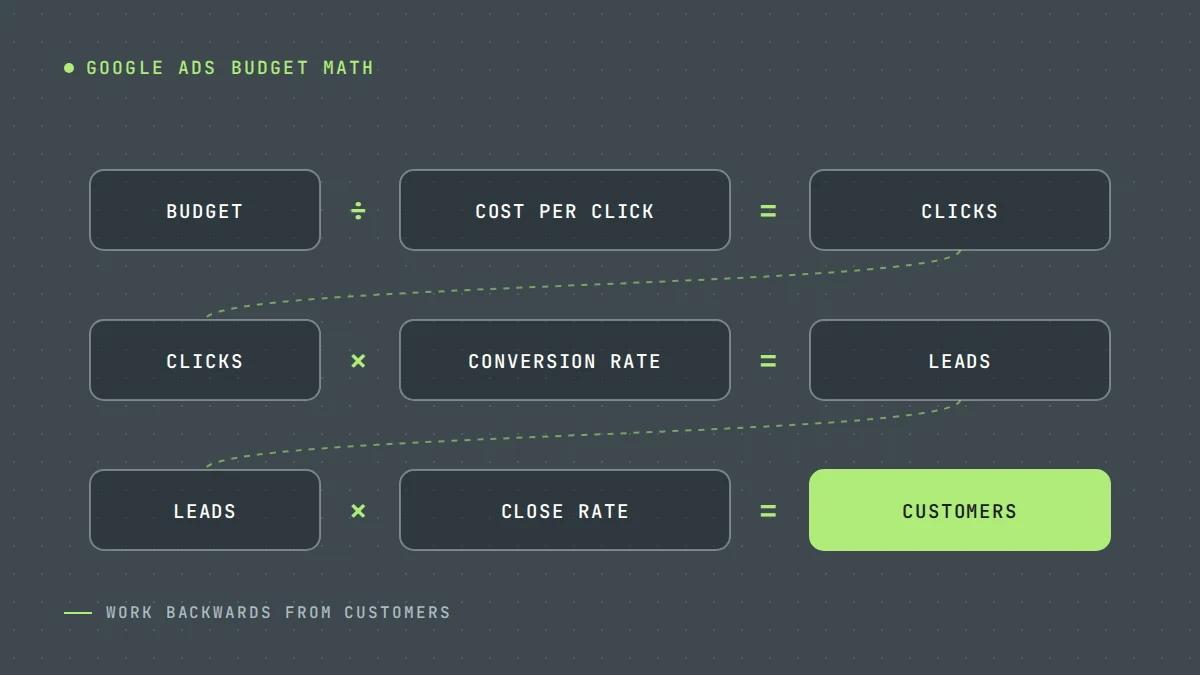
Instead of starting with a budget and hoping it works, start with what you need and work backwards. You need four numbers:
- Cost per click (CPC): what a click costs in your market, on average.
- Landing page conversion rate: the share of visitors who become leads (call, form or message).
- Lead-to-customer rate: the share of leads that become paying customers.
- Customer value: the gross profit from an average customer, ideally including likely repeat work.
From those, two simple formulas do most of the work:
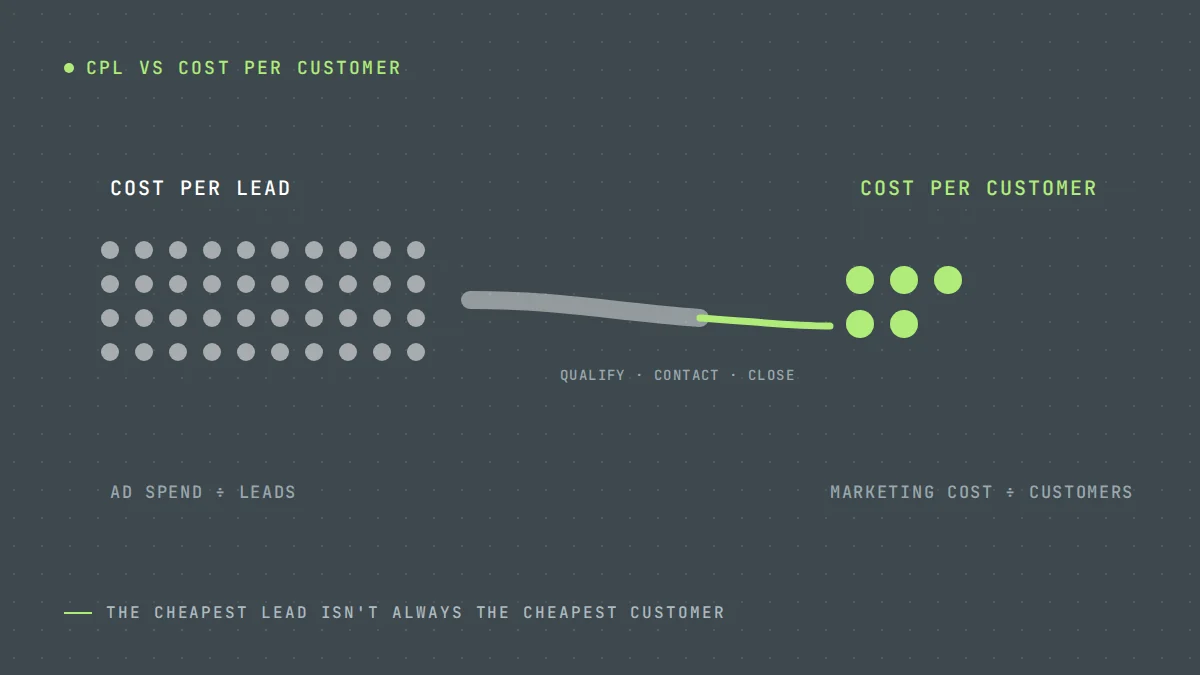
- Cost per lead = cost per click ÷ conversion rate
- Cost per customer = cost per lead ÷ lead-to-customer rate
A worked example
Illustrative example
The figures below are invented to show the math. They are not benchmarks for any trade or market.
A company wants 10 new customers a month from Google Ads. It estimates:
- Cost per click: $25
- Landing page conversion rate: 10%
- Lead-to-customer rate: 25%
Cost per lead = $25 ÷ 0.10 = $250. To win 10 customers at a 25% close rate, it needs 40 leads. 40 leads × $250 = $10,000 a month, or $1,000 per customer.
Now suppose a better landing page lifts the conversion rate from 10% to 15%, with everything else unchanged:
| Metric | Before | After |
|---|---|---|
| Conversion rate | 10% | 15% |
| Cost per lead | $250 | about $167 |
| Budget for 40 leads | $10,000 | about $6,700 |
| Cost per customer | $1,000 | about $667 |
Same clicks, same market, same bids. The improvement came entirely from the landing page.
The example shows why budget conversations should not stop at the cost per click. The page, the follow-up and the close rate often matter as much as the auction. If those numbers are weak, raising the budget mostly buys more of the same result. Our guide to landing pages that do not generate enough leads covers the most common fixes.
How to estimate your numbers before spending
You do not need perfect figures to start. Reasonable estimates are enough for a first budget, and real data replaces them within weeks.
- Cost per click: Google's Keyword Planner shows estimated top-of-page bid ranges for keywords in your area. Treat them as a rough guide rather than a price.
- Conversion rate: if you have run ads before, use your own history. If not, start with a cautious assumption and update it quickly once real data arrives.
- Lead-to-customer rate: look at your existing enquiries from any source. Of the last twenty or so people who contacted you, how many hired you?
- Customer value: use gross profit, not revenue. A $10,000 job with a $3,000 margin is worth $3,000 for this calculation.
Other costs to include
Ad spend is not the only cost of running Google Ads. When you calculate what a customer really costs, include:
- Management fees, if an agency or freelancer runs the account.
- Landing page design and hosting.
- Call tracking and other software.
- The time your team spends handling leads.
Leaving these out makes Google Ads look more profitable than it is, and makes comparisons with other channels unfair. We explain how to account for them in cost per lead vs cost per customer.
Why cheap clicks can be expensive
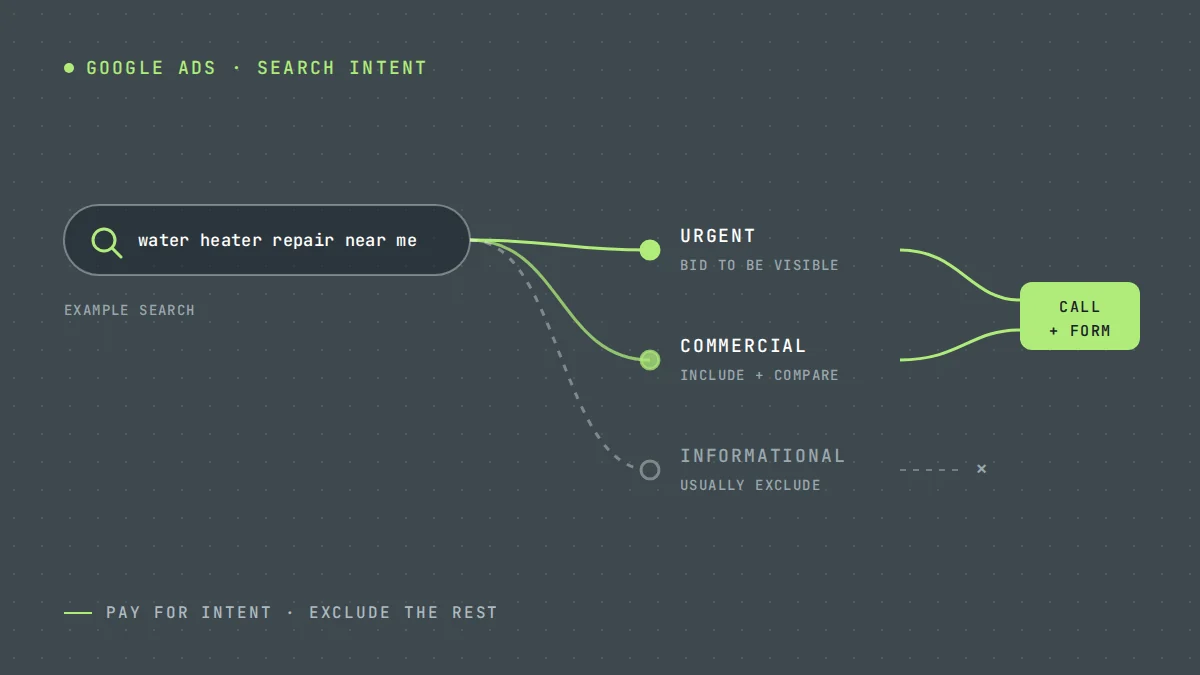
It is easy to celebrate a low cost per click. But cheap clicks are often cheap because fewer advertisers want them, usually because they convert poorly. Informational searches, broad keywords and searches from outside your service area can all look inexpensive while producing few real enquiries.
The number that matters is what it costs to win a customer, not what it costs to get a visitor.
Setting a starting budget
A few principles help first-time budgets work:
- Start with your most valuable service, not your whole service list. Spreading a small budget across ten services gives each one too little data to learn from.
- Give campaigns enough budget to learn. A campaign that gets a handful of clicks a day will take a long time to show whether it works.
- Plan for a learning period. The first weeks are for finding out what your real CPC, conversion rate and lead quality look like.
- Review against customers, not just leads. After the first month or two, check which leads became jobs and adjust.
Is Google Ads worth it for a small service business?
It can be, when three things are true: people search for your service in your area, your landing page and follow-up can turn clicks into customers, and the value of a customer comfortably exceeds what it costs to win one. The worked example above is the quickest way to test the third condition with your own numbers.
If you would like help working out realistic numbers for your market, our Google Ads management and PPC management services start with exactly that analysis, and our free audit includes a first look at it. You will know what a sensible budget looks like before you commit to one.
Questions owners ask
How much should a small service business spend on Google Ads?
Work backwards. Decide how many customers you need, estimate your close rate, landing page conversion rate and cost per click, then calculate the budget. The worked example in this article shows the math.
Why can daily Google Ads spend exceed my budget?
Google may spend up to twice your average daily budget on a given day to take advantage of busier days, but it will not charge more than your average daily budget multiplied by 30.4 over a month.
Is Quality Score part of the Google Ads auction?
No. Google describes Quality Score as a diagnostic tool on a 1 to 10 scale. The auction uses Ad Rank, which considers your bid, the quality of your ad and landing page, and other factors.
How much does Google Ads cost per month for a small business?
There is no fixed monthly price. You choose the budget and Google charges per click, so the real question is how many clicks you need. Multiply your expected cost per click by the clicks needed to produce the leads you want, using your landing page conversion rate. Management fees, if you use an agency, are separate from ad spend.
What is the average cost per click for plumbers?
Ubersuggest estimated the average cost per click for "emergency plumber" in the US at about $75 in September 2026, one of the highest of the trade searches we checked. Planned work such as water heater replacement was lower, at about $33. Local prices can be well above or below these national averages.
Sources
Platform details in this article are based on the official documentation below. Platforms change their products often, so check the latest version before making decisions.
Want us to look at your own numbers?
Get a free lead generation audit. We will review your ads, landing pages and tracking, and show you where enquiries are slipping away. If nothing is broken, we will tell you that too.

LeadWise MarketingAn owner-operated lead generation agency based in Cape Town, South Africa, working with service businesses across the United States and Europe. More about LeadWise.