Cost per lead vs customer acquisition cost: What service businesses should track
Cheap leads feel like progress. But the number that decides whether marketing is profitable is what it costs to win a customer, and the two can move in opposite directions.
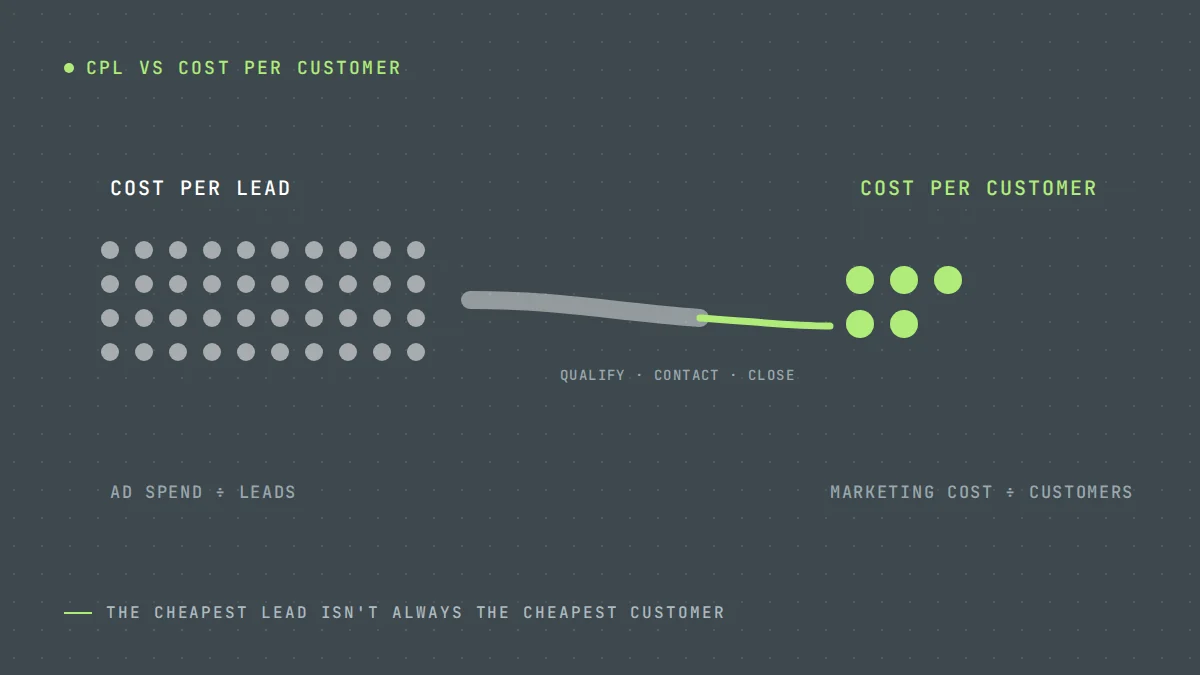
Cost per lead is the number most marketing reports lead with. It is easy to calculate, it updates daily, and it feels like a direct measure of whether advertising is working. So when it goes down, everybody relaxes.
But it is not, at least not on its own. A campaign can cut its cost per lead in half and make the business less money. To know whether marketing pays, service businesses need to track what it costs to win a customer, and the steps in between.
Cost per lead vs cost per customer: definitions
Cost per lead (CPL) is the amount spent on advertising divided by the number of leads it produced.
Cost per lead = ad spend ÷ leads
Cost per customer, often called customer acquisition cost (CAC), is the total cost of marketing divided by the number of new customers it produced.
Cost per customer = total marketing cost ÷ new customers
Two differences matter. First, the denominator: leads versus customers. Second, the numerator: CPL usually counts ad spend only, while cost per customer should include everything it took to win the customer, such as management fees, landing pages, software and, ideally, sales time.
Why cost per lead misleads on its own
Cost per lead treats every lead as equal. A homeowner ready to book a replacement and a renter asking for a price out of curiosity both count as one lead. The cost of a lead goes down as it gets easier to submit one, but the quality usually goes down with it.
Illustrative example
These numbers are invented to show the effect. They are not benchmarks.
Two campaigns each spend $4,000 in a month:
| Metric | Campaign A | Campaign B |
|---|---|---|
| Leads | 80 | 32 |
| Cost per lead | $50 | $125 |
| Qualified leads | 16 | 20 |
| Customers | 4 | 8 |
| Cost per customer | $1,000 | $500 |
Judged on cost per lead, Campaign A looks two and a half times better. Judged on customers, Campaign B wins twice as much work at half the cost per customer. It also gave the sales team 48 fewer leads to call.
This pattern is common when a campaign is optimized purely for lead volume. Ad platforms are very good at finding people who fill in forms. Whether those people become customers is a separate question, and one they can only learn to answer if you feed the results back.
The metrics between a lead and a customer
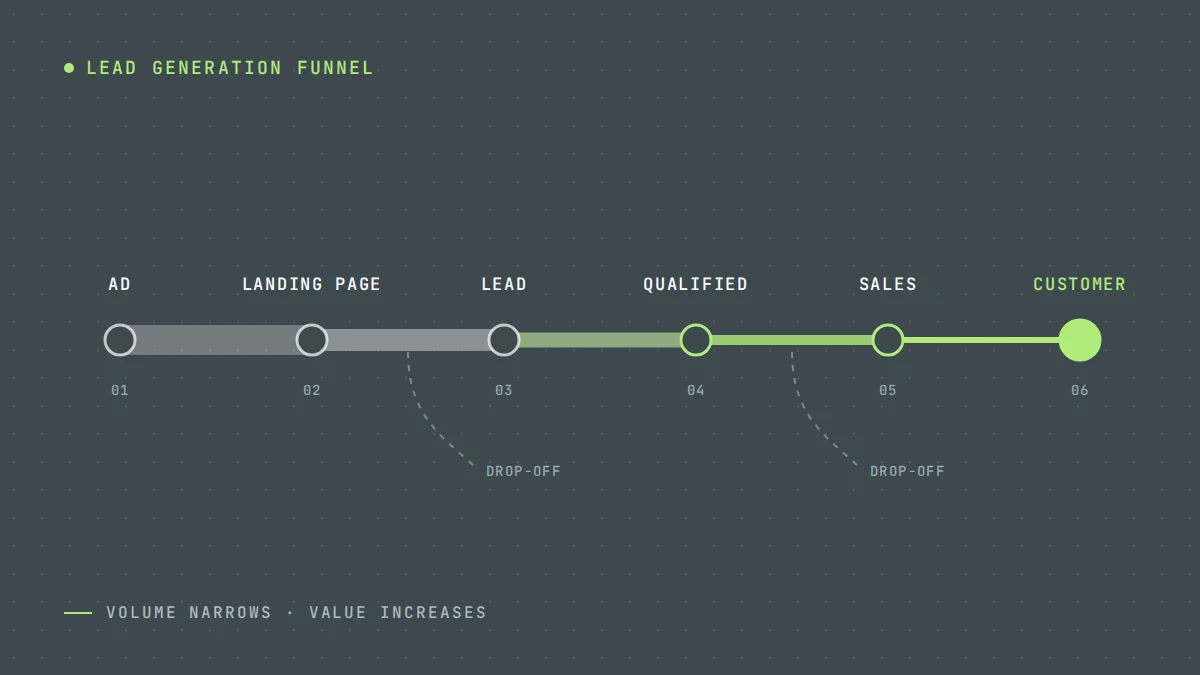
Cost per lead and cost per customer are the two ends of a chain. The links in between show where things go right or wrong:
- Qualified lead rate: the share of leads that meet your definition of a real opportunity, such as the right service, area and timeframe.
- Contact rate: the share of leads your team actually speaks to.
- Appointment or quote rate: the share of contacted leads who book an estimate, inspection or consultation.
- Close rate: the share of quotes or appointments that become paying work.
Each has its own cost version: cost per qualified lead, cost per appointment and so on. For most service businesses, cost per qualified lead and cost per booked appointment are the most useful day-to-day numbers, because they arrive faster than closed sales but correlate with them much better than raw leads do.
For a stage-by-stage view of where each metric sits, see lead generation funnel: from ad click to customer.
What to watch depends on how your customers buy
- Emergency and repair trades, such as plumbing, electrical repair and HVAC breakdowns, have short cycles. A lead often becomes a job the same day, so cost per booked job can be tracked quickly.
- Considered purchases, such as solar, roof replacement and remodeling, can take weeks or months. Cost per customer arrives late, so cost per qualified lead and cost per appointment become the leading indicators in the meantime.
- Mixed businesses, such as an HVAC company doing both repairs and system replacements, should track the two separately. A repair lead and a replacement lead are worth very different amounts.
How to track cost per customer in practice
You do not need an expensive system. You need four things to connect.
- Source data on every lead. When a lead arrives, record where it came from: the campaign, and where possible the click identifier Google or Meta adds to the URL. A well-built form captures this automatically.
- A status for every lead. In a CRM, or even a shared spreadsheet, record whether each lead was qualified, contacted, quoted and won, and the job value.
- A regular reconciliation. Monthly is enough for most businesses: match customers won back to their original lead source.
- Feedback to the ad platforms. Google Ads (offline conversion imports) and Meta (Conversions API) both let you send outcomes, such as qualified leads or closed deals, so their bidding can learn which clicks lead to real work.
A simple starting spreadsheet
Columns: date · name · source · campaign · service requested · qualified (yes/no) · contacted (yes/no) · quoted (yes/no) · won (yes/no) · job value · notes. That is enough to calculate every metric in this article.
Lead generation ROI
Once you know cost per customer, you can judge return on investment properly. Use gross profit rather than revenue, because a large job with thin margins may be worth less than a smaller job with healthy ones.
Marketing ROI = (gross profit from new customers − marketing cost) ÷ marketing cost
Two refinements make it more accurate:
- Include repeat value. A new customer who signs a maintenance plan or comes back for future work is worth more than their first job. Many service businesses underestimate this lifetime value.
- Use a realistic time window. For long sales cycles, judge a month's marketing on the customers it eventually produced, not the customers who happened to close that month.
What a good cost per customer looks like
There is no universal number. A good cost per customer is one your margins can comfortably support. A practical way to set a ceiling:
Maximum cost per customer = gross profit per customer × the share you are willing to invest to win it
Illustrative example
If an average new customer produces $2,000 in gross profit, including likely repeat work, and the business is willing to invest a quarter of that to win them, the ceiling is $500 per customer. Campaigns consistently above it need fixing or cutting; campaigns well below it may deserve more budget.
Common mistakes
- Celebrating a falling CPL without checking whether qualified leads or customers fell too.
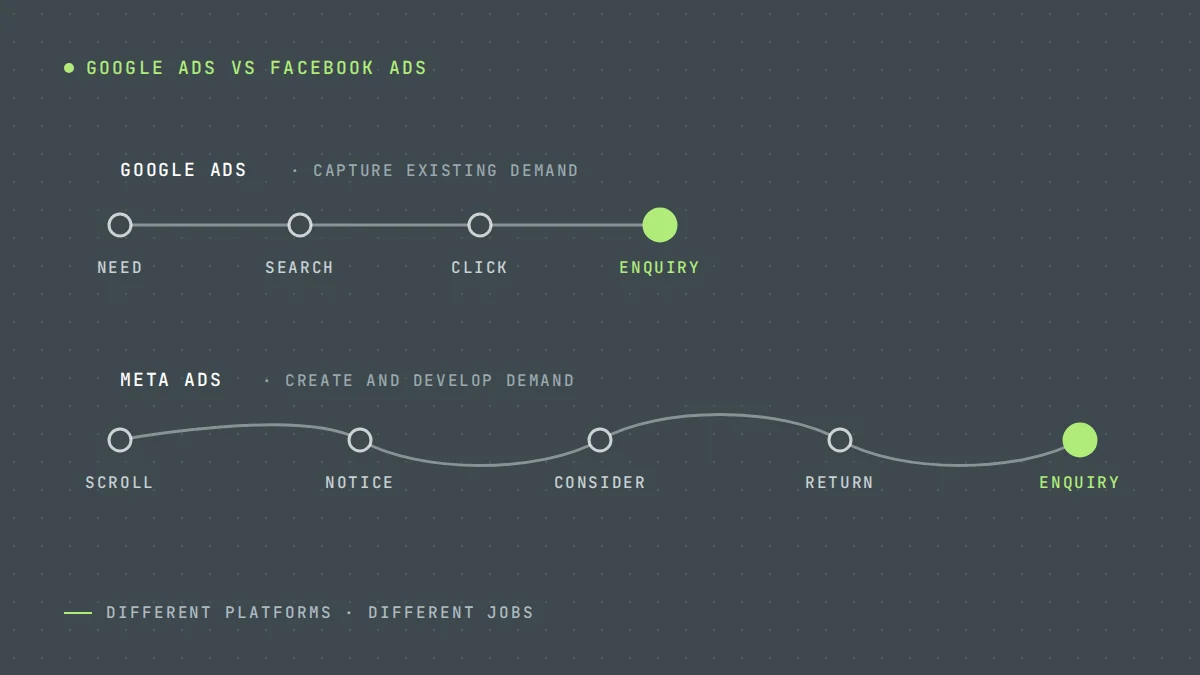
- Comparing channels on CPL alone. Channels with easier forms usually win on CPL and can lose on customers. See Google Ads vs Facebook Ads.
- Leaving costs out of cost per customer, such as fees, software and landing pages.
- Not recording lead outcomes, which makes cost per customer impossible to calculate and leaves ad platforms optimizing blind.
- Judging long sales cycles too early. A solar campaign's first month may show leads but few customers, and that can be normal.
Where to start
If you track nothing beyond cost per lead today, start small: add a lead source and a won/lost column to wherever your enquiries land, and review it monthly. Within a quarter you will know which campaigns produce customers.
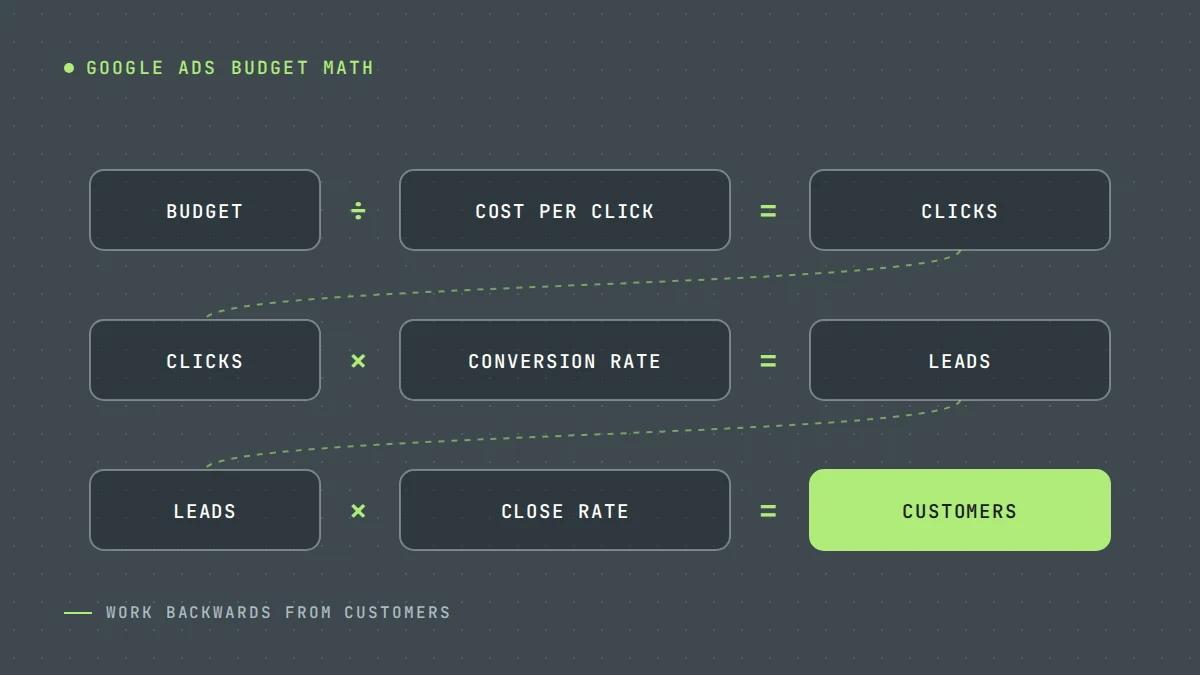
That is why this is built into how we run campaigns. Our lead generation systems capture source data on every lead, and our PPC management is judged on qualified leads and customers rather than raw volume. For the budget side of the equation, see how much Google Ads costs for a service business. And if you would like us to work out your real cost per customer with you, the free audit is the place to start.
Questions owners ask
What is the difference between cost per lead and customer acquisition cost?
Cost per lead measures what it costs to generate an enquiry, usually from ad spend alone. Customer acquisition cost measures the total cost of winning a paying customer, including fees and tools, divided by the number of new customers.
What is a good cost per lead for a service business?
There is no universal figure. A good cost per lead is one that produces customers at a cost your margins support. Set a ceiling for cost per customer first, then work back to the cost per lead that fits.
How do I calculate marketing ROI?
Marketing ROI equals gross profit from new customers minus marketing cost, divided by marketing cost. Use gross profit rather than revenue, and include likely repeat work where you can.
How do you calculate cost per lead?
Divide what you spent on a channel by the number of leads it produced in the same period. If you spent $3,000 on Google Ads in a month and received 60 tracked calls and forms, your cost per lead was $50. Count only real enquiries, not clicks or page views.
How do you calculate customer acquisition cost?
Divide your total marketing cost for a period, including ad spend and any agency or software fees, by the number of new paying customers that marketing produced in the same period. A total cost of $6,000 and 12 new customers gives a customer acquisition cost of $500.
Sources
Platform details in this article are based on the official documentation below. Platforms change their products often, so check the latest version before making decisions.
Want us to look at your own numbers?
Get a free lead generation audit. We will review your ads, landing pages and tracking, and show you where enquiries are slipping away. If nothing is broken, we will tell you that too.

LeadWise MarketingAn owner-operated lead generation agency based in Cape Town, South Africa, working with service businesses across the United States and Europe. More about LeadWise.