Google Ads vs Facebook Ads for lead generation
The question is not which platform is better. It is which job you need done: capturing people already looking, or reaching people who have not started yet.
"Should we run Google Ads or Facebook Ads?" is one of the most common questions service business owners ask. Pick the wrong one and you can burn a quarter's budget learning the lesson. It is also slightly the wrong question.
Google Ads and Facebook Ads (now part of Meta Ads, which covers Facebook and Instagram) are not two versions of the same thing. They reach people at different moments, with different levels of intent, and they need different approaches to produce good leads. The better question is: which job do you need done first?
The short answer
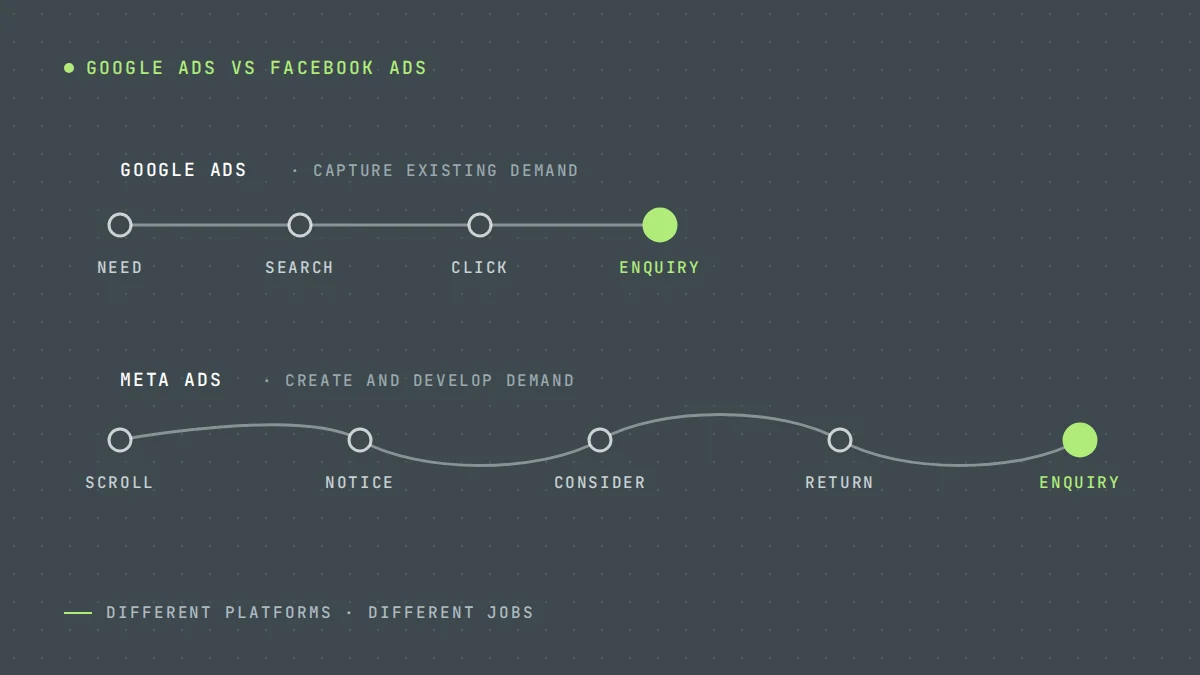
Google Ads captures existing demand. It shows your ads to people who are already searching for your service. Leads tend to have higher intent, and the channel suits urgent and actively researched services.
Facebook Ads creates and develops demand. It shows your ads to people who match a profile and location but are not searching yet. It can reach many more people, but leads usually need more qualification. It suits considered, higher-value and visual services.
Many service businesses end up using both, with each doing a different job.
How each platform finds people
On Google, the search is the targeting. A person types "ac repair near me" and Google decides which ads to show based on the keywords advertisers have chosen, their bids and the quality of their ads and landing pages. You are reaching someone at the moment of need.
On Facebook and Instagram, there is no search. Meta shows ads to people based on location, demographics, interests and, increasingly, its own prediction of who is likely to respond. You are reaching someone who might need your service, before they have decided to look.
That single difference explains most of what follows.
Google Ads vs Facebook Ads: side by side
| Factor | Google Ads | Facebook Ads (Meta) |
|---|---|---|
| When you reach people | While they are searching | While they are scrolling |
| Intent | Typically high: they are looking now | Typically lower: interest must be created |
| Best-fit services | Urgent, repair and actively researched services | Considered, higher-value, visual services |
| Lead volume potential | Limited by how many people search | Larger pool, not limited by search volume |
| Lead quality | Usually higher by default | Varies widely; depends on offer and qualification |
| What drives results | Keywords, search terms, landing pages | Offer, creative, audience, form design |
| Sales cycle fit | Short and medium cycles | Medium and long cycles, with follow-up |
| Creative needs | Text ads and assets | Images and video, refreshed regularly |
The table describes typical patterns, not rules. A well-run Meta campaign can produce excellent leads, and a badly run Google campaign can produce terrible ones.
When Google Ads should lead
Google Ads is usually the right starting point when:
- The service is urgent. Emergency plumbing, heating or cooling breakdowns, electrical faults and active roof leaks are searched for, not discovered on social media. See how this plays out for plumbing companies.
- People actively research the service. Replacements and installations with steady search demand, such as water heaters, AC systems or panel upgrades.
- You need leads soon. Search captures existing demand, so it can produce enquiries sooner than building demand from scratch.
- Your team is set up for calls. Search traffic, especially on mobile, often turns into phone calls.
When Facebook Ads should lead
Facebook and Instagram are often the better starting point when:
- The purchase is considered. Solar, roof replacements, remodeling and system upgrades involve research, conversations with family and comparison over weeks or months. See our notes on solar lead generation.
- The result is visual. Before-and-after project photos and short videos of real work can stop someone mid-scroll.
- Search volume is small or expensive. In some markets, the number of people searching is limited, or the clicks are costly. Meta lets you reach homeowners who fit your profile regardless.
- You have a clear offer. "Free roof inspection for homeowners in [area]" gives someone a reason to act; "We do roofing" does not.
Why lead quality differs, and how to fix it on Facebook
Because Facebook users are not searching, some of them will fill in a form out of mild curiosity. Meta's instant forms make this even easier, since the form opens inside the app with details already filled in.
That is not a reason to avoid Meta. It is a reason to build qualification in:
- Ask qualifying questions. Homeownership, service type, location and timeframe filter out many poor fits.
- Use a higher-intent form setting. Meta offers form options that add a review step before submission, which reduces accidental and low-effort submissions.
- Make the offer specific. Specific offers attract specific people.
- Feed outcomes back. Telling Meta which leads became qualified or booked, through your CRM or Meta's Conversions API, helps its systems find more people like them.
- Call fast. Interest from a social ad fades quickly. Leads contacted promptly are far more likely to engage.
Comparing costs fairly
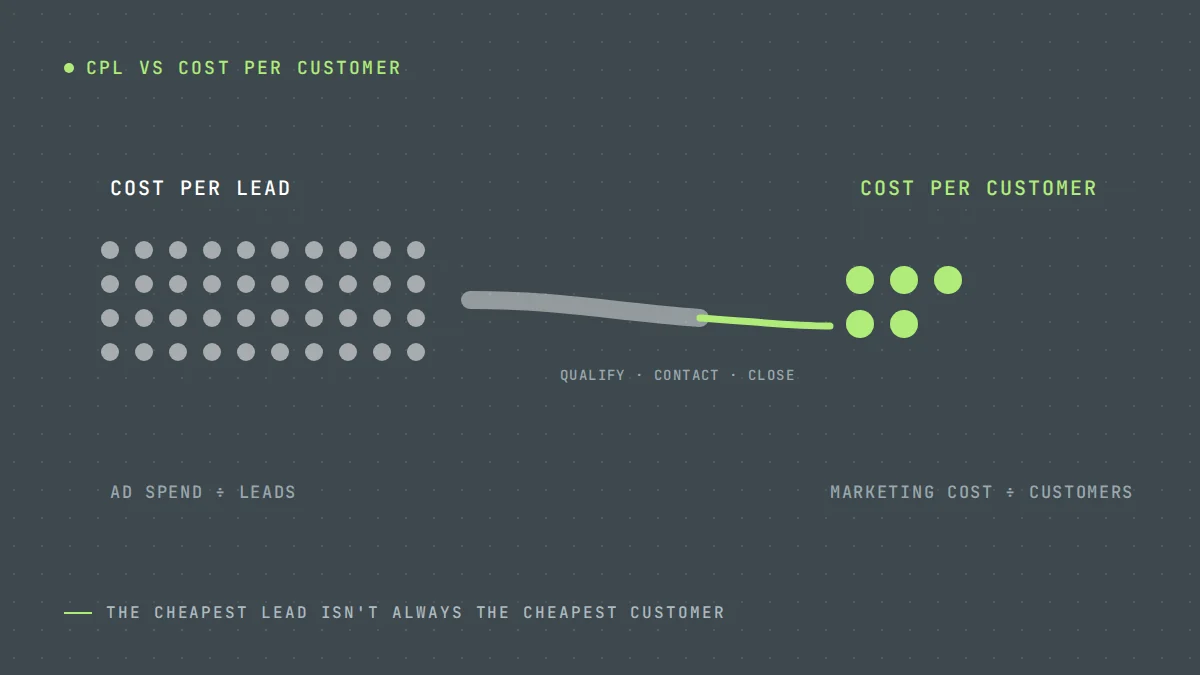
It is tempting to compare the two platforms on cost per lead alone. That usually flatters Facebook, because its leads are often cheaper, and it hides the real question: which one produces customers at an acceptable cost?
Illustrative example
These figures are invented to show the comparison, not benchmarks.
| Metric | Google Ads | Facebook Ads |
|---|---|---|
| Monthly spend | $3,000 | $3,000 |
| Leads | 30 | 60 |
| Cost per lead | $100 | $50 |
| Leads that became customers | 6 | 6 |
| Cost per customer | $500 | $500 |
On cost per lead, Facebook looks twice as efficient. On cost per customer, they are identical, and Facebook's version required your team to handle twice as many leads to get there. The reverse can also happen. The point is to measure beyond the lead.
We go deeper into this in cost per lead vs cost per customer.
Using both together
For many service businesses, the strongest setup uses both platforms in their natural roles:
- Google Ads captures people searching now, especially for urgent and high-intent services.
- Meta Ads reaches homeowners before they search, building familiarity and generating enquiries for considered services.
- Meta remarketing follows up with people who visited your site from Google but did not enquire, keeping you in consideration while they decide.
The order matters when budgets are limited. Start with the channel that matches how your most profitable service is bought, get it working, then add the second.
How to decide
Answer these questions about your most important service:
- Do people search for it when they need it? If yes, start with Google.
- Is it a considered purchase with a long decision? Meta will likely play a large role.
- Is the result visual or the savings story strong? That favors Meta.
- Can your team call new leads back quickly? That is essential for Meta and important for both.
- Is search demand in your area limited or very expensive? Consider leading with Meta.
If the answers point both ways, start with the platform that matches your highest-margin service, and measure it on customers, not just leads.
Want help deciding? See our Google Ads and Meta Ads services, or request a free audit and we will recommend a starting channel for your market, with the reasoning behind it.
Questions owners ask
Is Google Ads or Facebook Ads better for lead generation?
Neither is better in general. Google Ads usually suits urgent and actively searched services, while Facebook Ads usually suits considered, visual or higher-value services. Start with the platform that matches how your most profitable service is bought.
Why are Facebook leads often cheaper than Google leads?
Instant forms let people submit their details without leaving the app, and they are not actively searching. That lowers cost per lead but often lowers intent too, so qualifying questions and fast follow-up matter more.
Can I run Google Ads and Facebook Ads together?
Yes. A common setup uses Google Ads to capture active searches, Meta Ads to reach homeowners before they search, and Meta remarketing to stay visible to people who visited your site but did not enquire.
Should contractors use Google Ads or Facebook Ads?
Start with Google Ads if most of your work comes from urgent problems people search for, such as plumbing or HVAC repairs. Start with Facebook Ads if you sell bigger planned projects, such as roof replacements, remodeling or solar, where you need to reach homeowners before they search. Many contractors end up running both. See Facebook ads for contractors and Google Ads management.
Which is cheaper, Google Ads or Facebook Ads?
Facebook usually costs less per click and per lead. Google usually produces more leads that turn into jobs, because the person has already searched for the service. Compare the two on cost per booked job, not cost per lead, before you move budget.
Sources
Platform details in this article are based on the official documentation below. Platforms change their products often, so check the latest version before making decisions.
Want us to look at your own numbers?
Get a free lead generation audit. We will review your ads, landing pages and tracking, and show you where enquiries are slipping away. If nothing is broken, we will tell you that too.

LeadWise MarketingAn owner-operated lead generation agency based in Cape Town, South Africa, working with service businesses across the United States and Europe. More about LeadWise.