Lead generation funnel: From ad click to customer
A lead generation funnel is only as strong as its weakest stage. Here is how the whole system fits together for a service business, and how to find where yours is losing people.
You spent the money. The leads came in, or at least some did. And yet the month still felt slow, and nobody can say exactly why.
Most service businesses judge their marketing on two numbers: how much they spent and how many leads came in. When those numbers disappoint, the usual response is to change the ads or raise the budget.
But the problem is rarely that simple. Between an ad click and a paying customer sit six stages, and each one either moves people forward or loses them. This guide walks through each stage of a lead generation funnel for a service business: what it does, how it leaks, and what to measure. Then it shows how to find the weakest stage in your own funnel.
What is a lead generation funnel?
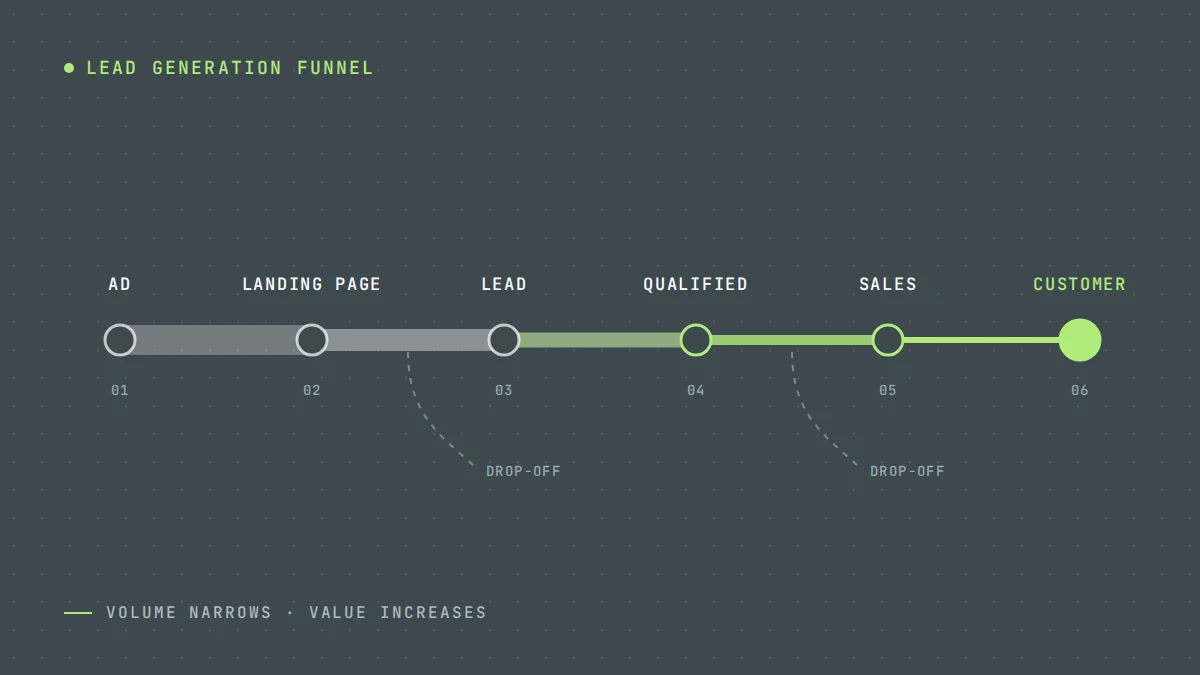
A lead generation funnel is the sequence of steps that turns a stranger into a customer. For a service business running paid advertising, it usually looks like this:
- Ad: someone sees your ad on Google or Meta and clicks.
- Landing page: they arrive on a page about the service they need.
- Lead capture: they call, fill in a form or send a message.
- Qualification: the enquiry is checked against what you actually do: service, area, budget, timing.
- Sales follow-up: your team contacts them, quotes and books the work.
- Customer: the job is won, and the result is recorded.
It is called a funnel because the numbers shrink at every stage. That is normal. The goal is not to stop the shrinkage; it is to make sure people drop out for the right reasons, like being outside your service area, and not the wrong ones, like a form that does not work on a phone.
Remember this
A funnel is a chain. Improving a strong stage does little if a weak stage further along is losing most of the people you have paid to attract. Find the weakest link first.
Stage 1: The ad
This stage has one job: to reach the right person at the right moment with a message that makes them want to know more.
On Google Ads, the "right moment" is when someone searches for your service. On Meta Ads, it is when someone in your area and target profile is scrolling, before they have started looking.
How does it leak? The ad reaches the wrong people. Broad keywords trigger ads for searches like "plumbing jobs" or "how to fix a leaking tap". Loose targeting shows ads to people outside your service area. Vague messages attract curious clicks instead of people with a real need.
What should you measure? Click-through rate tells you whether the message resonates, but the more important question is which searches or audiences the clicks come from. On Google, that means reviewing the search terms report regularly. On Meta, it means watching which audiences and ads produce qualified leads, not just cheap ones.
Stage 2: The landing page
This stage has one job: to confirm to the visitor that they are in the right place, give them a reason to trust you, and make the next step obvious.
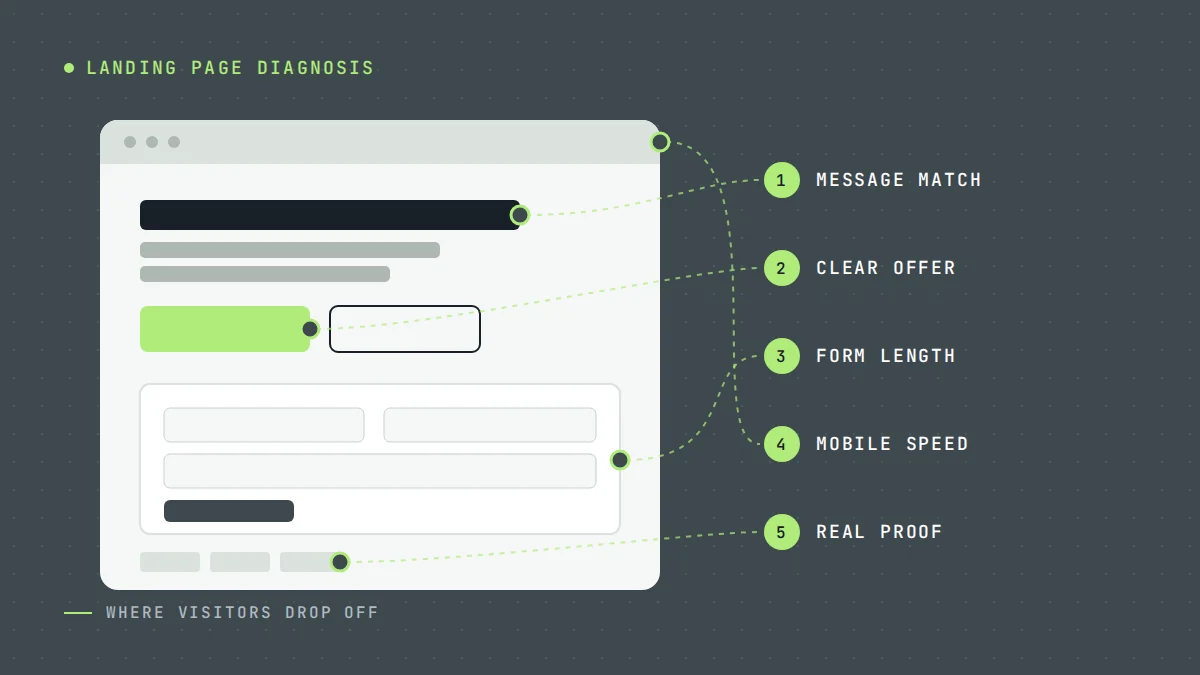
How does it leak? This is where many funnels lose the most people. Common causes include sending paid traffic to a homepage with a dozen options, a headline that does not match the ad, slow load times on mobile, and no clear action above the fold. We cover nine specific causes in why your landing page is not generating enough leads.
What should you measure? Landing page conversion rate, meaning the share of visitors who become leads. Look at it by device, because a page that works on desktop can fail on a phone, and most local service searches happen on phones.
Stage 3: Lead capture
This stage has one job: to make it easy for a ready person to get in touch, in the way they prefer.
For emergency trades, that usually means a phone call. For considered purchases like solar or a kitchen remodel, it is more often a form or a consultation request. Many businesses need both.
How does it leak? Forms that break on certain phones, phone numbers that are not tappable, forms with too many required fields for an urgent job, and calls that go to voicemail. A particularly expensive leak is invisible: leads that arrive but are not tracked, so nobody knows which campaign produced them.
What should you measure? Total leads by type (calls, forms, messages), and whether every one is recorded with its source. If your ad platform says you got twenty conversions and your inbox shows twelve enquiries, fix the tracking before changing anything else.
Stage 4: Qualification
This stage has one job: to separate enquiries worth your team's time from those that are not, as early and as cheaply as possible.
Qualification can happen on the form (questions about service, location, homeownership, budget range or timeframe), on the phone, or both. The right depth depends on the business. An emergency plumbing call needs almost no form qualification, because speed matters more. A solar consultation form can reasonably ask several questions, because a poor-fit appointment costs a consultant hours.
How does it leak? In two directions. Too little qualification floods your team with poor fits and makes the channel look worse than it is. Too much qualification scares off good prospects. There is also a quieter leak: when the ad platform is optimized for any form submission, it learns to find people who fill in forms, not people who become customers.
What should you measure? Qualified lead rate, meaning the share of leads that meet your agreed definition. That definition needs to be written down before campaigns launch. We go deeper into this on our lead generation systems page.
Stage 5: Sales follow-up
This stage has one job: to turn a qualified enquiry into a booked job or appointment.
This is usually your team's stage, not the marketing agency's. But it has a huge effect on marketing results, so it belongs in the funnel conversation.
How does it leak? Slow response times, missed calls, no follow-up after the first attempt, and quotes that are sent and then forgotten. For considered purchases, a lead that does not hear back quickly often books whoever called first.
What should you measure? Contact rate (how many leads you actually speak to), appointment or quote rate, and time to first response if your systems can record it.
Stage 6: The customer
This stage has one job: to win the work, and feed the result back into the system.
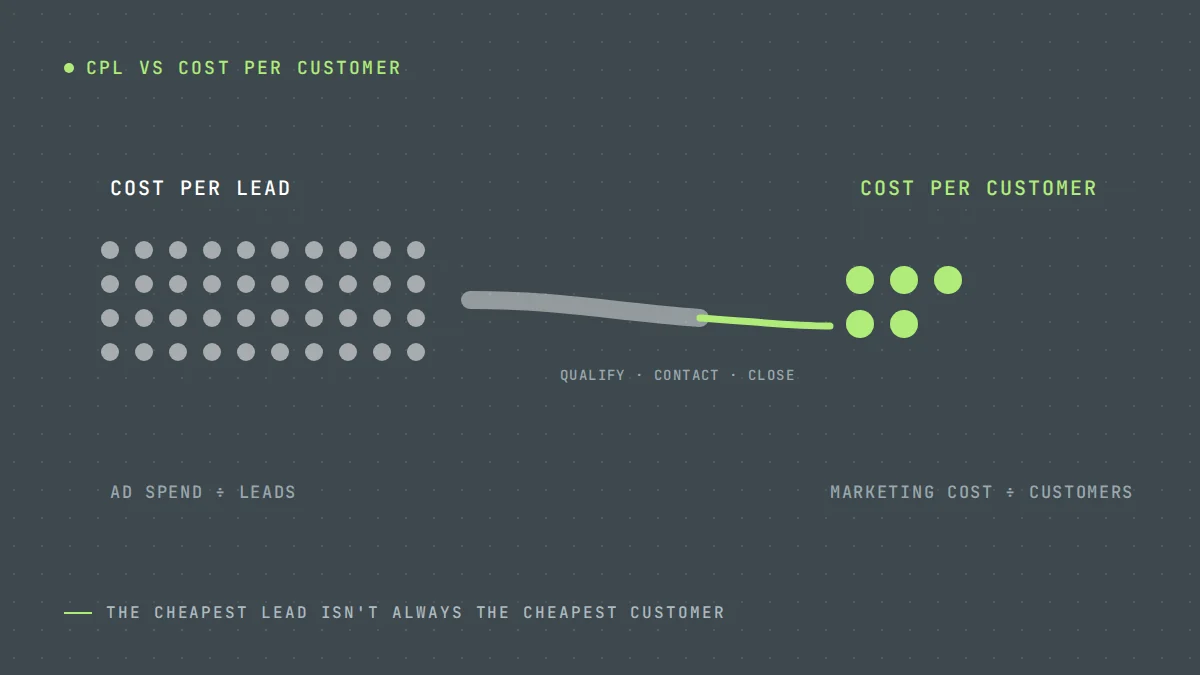
The last stage is where marketing proves its value, and it is the one most often left out of reporting. If nobody records which leads became customers, you cannot tell which campaigns produce jobs. You end up optimizing for cost per lead instead of cost per customer, and those two numbers can move in opposite directions. We explain why in cost per lead vs cost per customer.
What should you measure? New customers by source, revenue or gross profit by source where you have it, and cost per customer.
How to find the leak in your funnel
You do not need perfect data to find the weakest stage. You need rough counts for each stage over the same period, usually the last 30 to 90 days.
Illustrative example
The numbers below are invented to show the method. They are not benchmarks, and your numbers will be different.
| Stage | Count | Passed to next stage |
|---|---|---|
| Landing page visits | 1,000 | 3% became leads |
| Leads | 30 | 50% were qualified |
| Qualified leads | 15 | 40% were contacted |
| Contacted | 6 | 50% booked |
| Customers | 3 |
In this example, the landing page conversion rate might look like the obvious problem. But the bigger surprise is that only 40% of qualified leads were ever contacted. Fixing follow-up could double the number of customers without spending another dollar on ads, while a better landing page would mostly send more leads into the same leaky follow-up process.
The lesson from the example applies generally: look at every stage before deciding where to spend effort. The biggest gains are usually in the stage nobody has been measuring.
Common lead generation funnel mistakes
- Optimizing the ads in isolation. Better ads send more people into the same weak landing page or follow-up process.
- Counting leads without counting outcomes. Twenty leads that produce no jobs are worse than eight that produce three.
- One funnel for every service. An emergency repair and a planned installation need different pages, forms and follow-up.
- No shared definition of a qualified lead. Marketing and sales end up arguing about lead quality with no agreed standard.
- Changing everything at once. When results change, you will not know why.
What happens after someone submits a lead?
In a well-built system, four things happen almost immediately:
- The lead is stored with its source: the campaign, keyword or ad that produced it, and click identifiers where available.
- The right person on your team is notified, by email, message or CRM alert.
- Your team contacts the lead, qualifies further and books a quote or appointment.
- The outcome is recorded, so marketing can be judged on jobs and not just enquiries.
The first two steps are marketing infrastructure. The last two are sales process. Both have to work for the funnel to pay.
Putting it together
A lead generation funnel is not a marketing diagram. It is a practical way to see where money turns into opportunities and where it disappears. Measure each stage, fix the weakest one first, and keep the whole chain in view.
If you would like help finding the weak point in yours, that is exactly what our free lead generation audit is for. We will look at every stage, show you where the money leaks, and tell you plainly what we would fix first. You can also see how the system applies to specific trades, such as plumbing and solar.
Questions owners ask
What are the stages of a lead generation funnel?
For a service business running paid ads, the stages are the ad, the landing page, lead capture (a call, form or message), qualification, sales follow-up and the customer. Each stage has its own job and its own way of leaking.
What is a good landing page conversion rate?
There is no universal benchmark worth trusting, because it depends on the service, offer, traffic source and market. Track your own rate by campaign and device, and judge changes against your own history.
How do I find which stage of my funnel is leaking?
Count how many people reach each stage over the same 30 to 90 days and compare each drop with what you would expect. The stage with the biggest unexplained drop, often follow-up or tracking, is where to start.
What is the difference between a lead generation funnel and a sales funnel?
A lead generation funnel ends when a qualified enquiry reaches your team: the ad, the landing page, the call or form, and qualification. A sales funnel carries on from there through the callback, quote and signed job. For a service business the two overlap, which is why it pays to track cost per lead and cost per customer side by side.
Does a lead generation funnel work for contractors?
Yes, and it is often simpler than in other businesses. Most contractor enquiries arrive as calls or short forms, so the funnel is short: a search or social ad, a page for that service, a tracked call or form, and a fast callback. The trade changes the details. See how it works for HVAC lead generation and roofing lead generation.
Sources
Platform details in this article are based on the official documentation below. Platforms change their products often, so check the latest version before making decisions.
Want us to look at your own numbers?
Get a free lead generation audit. We will review your ads, landing pages and tracking, and show you where enquiries are slipping away. If nothing is broken, we will tell you that too.

LeadWise MarketingAn owner-operated lead generation agency based in Cape Town, South Africa, working with service businesses across the United States and Europe. More about LeadWise.