Speed to lead: Why the first five minutes decide who gets the job
A lead that waits is a lead that keeps shopping. Response time is one of the cheapest things to fix in a service business, and one of the most expensive to ignore.
When a homeowner's water heater fails, they rarely call one plumber and wait. They search, tap two or three results, fill in a form or two, and go with whoever gets back to them first with a sensible answer.
That makes response time one of the few things in marketing that is almost entirely in your control. You cannot choose how many people search today. You can choose how long they wait.
Why response time matters so much
A lead is at its warmest at the moment it arrives. The person has the problem in front of them, the phone in their hand and a few minutes set aside to deal with it. An hour later they are back at work, or they have already booked someone else.
A widely cited Harvard Business Review study of online leads found that companies that tried to contact a lead within an hour were far more likely to qualify it than those that waited longer, and that many companies took more than a day to respond at all. The research is not about trades specifically, but the pattern matches what service businesses see every day.
What counts as fast enough
- Emergency work (burst pipes, no heat, no power): minutes. The customer will book whoever answers.
- Planned work (a new roof, a solar system, a remodel): within the hour during business hours. The customer is comparing, and the first good conversation sets the benchmark.
- After hours: an immediate automatic text or email that confirms the enquiry was received and says exactly when someone will call.
Where leads get stuck
Slow response is rarely laziness. It is usually a routing problem.
- Form submissions go to an email inbox nobody checks during jobs.
- Facebook lead ads sit inside Meta's system until someone downloads them.
- Leads go to the owner, who is on a roof.
- Nobody knows whose job it is to call.
Illustrative example
These numbers are invented to show the effect.
A business receives 60 leads a month. When the average first call happens after three hours, the team books 12 jobs. After moving to a five-minute alert and callback, the same 60 leads produce 18 jobs. Ad spend is unchanged. Cost per customer falls by a third.
How to respond faster without hiring
- Send every lead to a phone, not just an inbox. A text or push notification to whoever is on call is the single biggest improvement for most businesses.
- Connect Meta lead ads to your system. Use Meta's CRM integrations, Zapier or a webhook so instant form leads arrive the moment they are submitted.
- Send an instant acknowledgement. An automatic text such as "Thanks, this is Dave from ABC Plumbing. I will call you within 15 minutes" buys time and stops the customer from calling the next company.
- Set a clear owner. Decide who calls leads during business hours and who covers evenings and weekends.
- Use an answering service for peak periods. If you cannot answer the phone on busy days, a trained answering service is cheaper than the jobs you lose.
Measure it
Add two columns to wherever you track leads: time received and time of first contact. Review the gap weekly. Most businesses are surprised by their real average, and it usually improves as soon as someone is watching it.
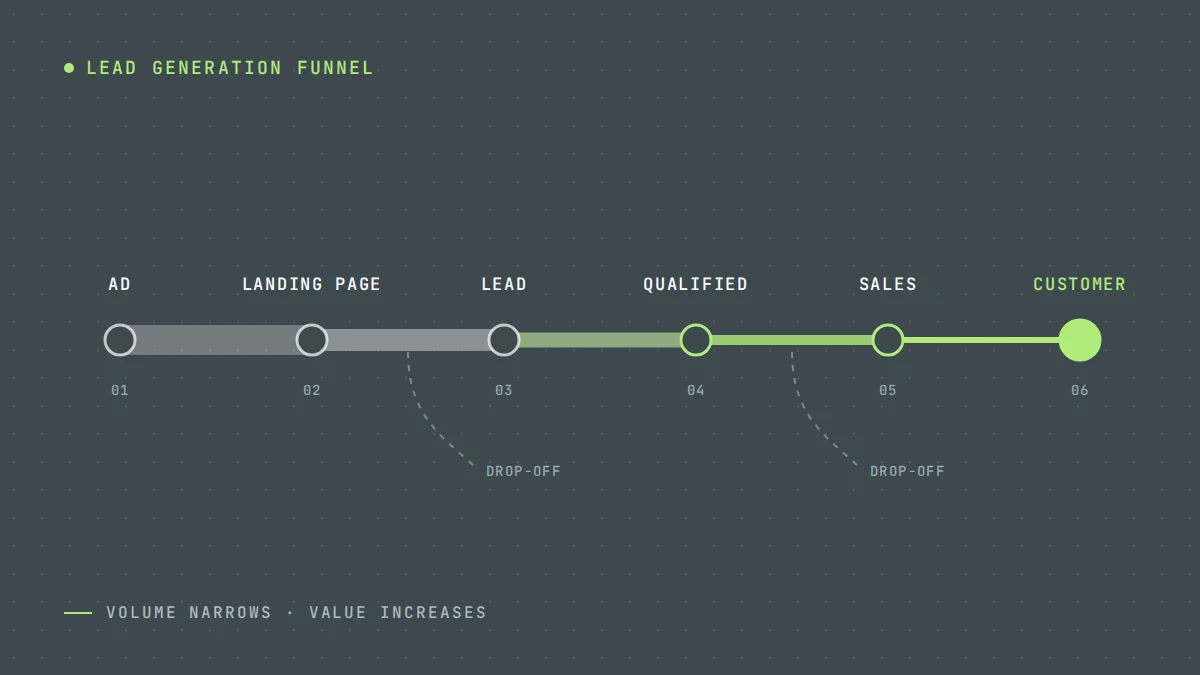
Speed also helps the rest of the funnel. Leads you reach quickly are easier to qualify, and their outcomes are easier to send back to Google and Meta. For the full picture, see the lead generation funnel and what missed calls cost a service business.
Where to start
Test your own process this week. Submit a form on your website and see how long it takes for someone to get back to you. If it is longer than you would wait as a customer, start with the routing.
Our lead generation systems include instant lead alerts and automatic replies as standard, because good ads are wasted on slow follow-up. If you would like a second opinion on your own process, the free audit covers it.
Questions owners ask
What is speed to lead?
Speed to lead is the time between a lead arriving and your business making contact with them. Shorter is better, especially when customers are contacting several companies at once.
Is an automatic reply enough?
No. An automatic text or email confirms the enquiry and holds attention, but it does not replace a real conversation. Use it to buy minutes, not hours.
What if I cannot answer during jobs?
Route leads to someone who can, such as an office manager, family member or answering service, and set a clear callback window in your automatic reply.
What is a good speed to lead time?
Aim to reply to every new enquiry within five minutes during working hours, with an automatic text or email that confirms you received it. Outside working hours, send the automatic reply straight away and call first thing the next working morning.
Does speed to lead matter for bought leads?
Even more. Leads bought from lead marketplaces are often sent to several companies at once, so the homeowner may hear from three or four businesses within minutes. With leads from your own ads you are usually the only company contacting that person, but a slow reply still loses jobs.
Sources
Want us to look at your own numbers?
Get a free lead generation audit. We will review your ads, landing pages and tracking, and show you where enquiries are slipping away. If nothing is broken, we will tell you that too.

LeadWise MarketingAn owner-operated lead generation agency based in Cape Town, South Africa, working with service businesses across the United States and Europe. More about LeadWise.