Google Ads for contractors and service businesses: How to turn search intent into leads
People tell Google exactly what they need. The businesses that win on Google Ads are the ones that build campaigns around that intent, and stop paying for everything else.
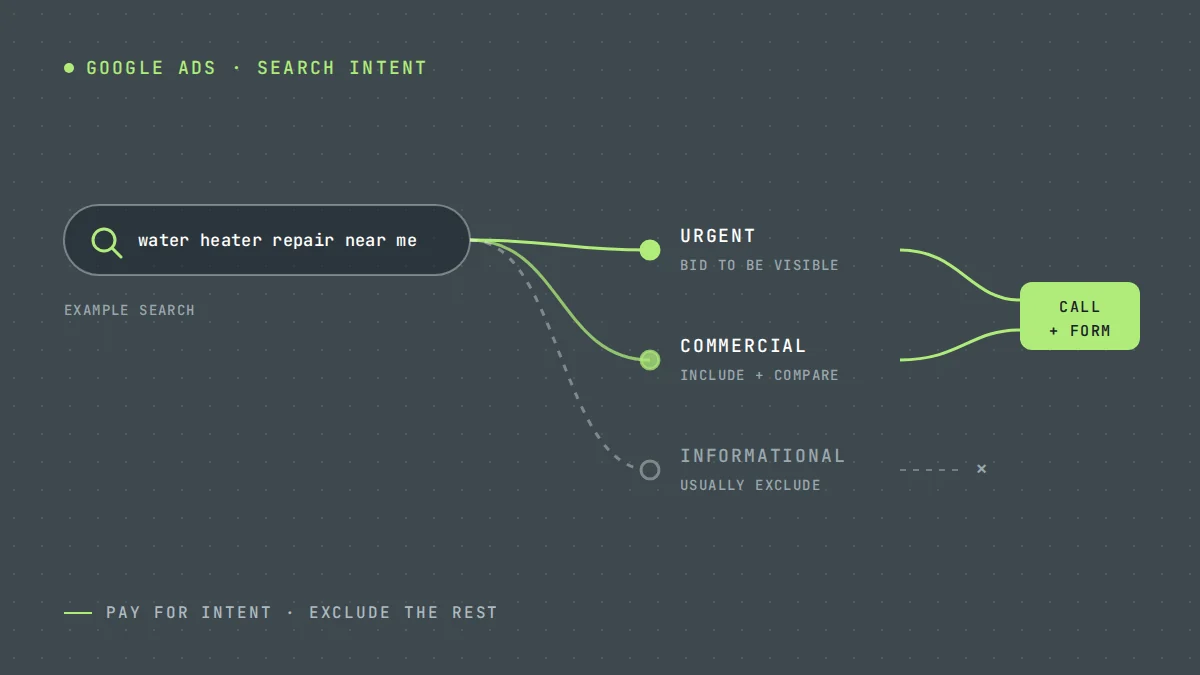
Google Ads is one of the few advertising channels where customers tell you exactly what they want before you pay to reach them. Someone searching "water heater repair" or "roof leak repair" has a problem, a location and usually a deadline.
That makes Google Ads a natural fit for service businesses. Unfortunately, it also makes it easy to waste money, because Google will happily spend your budget on searches that look relevant but never turn into work. This guide covers how to structure Google Ads so it captures real search intent and turns it into calls and form enquiries.
Why Google Ads suits service businesses
Most advertising interrupts people. Search advertising answers them. When a homeowner types a service into Google, they have already decided they need help; the remaining question is who they will call.
That has three practical consequences:
- Intent is visible. The search itself tells you what the person needs, often how urgently, and sometimes where.
- Results can be fast. A well-built search campaign can produce enquiries soon after launch, because it is capturing demand that already exists rather than creating it.
- Everything is measurable. Clicks, calls and form submissions can be tied back to specific searches, so budget decisions can be based on evidence.
The catch is that Google's systems are designed to find more places to show your ads. Without careful structure and ongoing review, campaigns drift toward searches that are cheap to buy but unlikely to convert.
Understand the three levels of search intent
Not every relevant-looking search is worth the same. For a service business, searches usually fall into three groups.
| Intent level | Example searches (illustrative) | What the person wants | How to treat it |
|---|---|---|---|
| Urgent | "emergency plumber", "ac not working", "roof leaking" | Help now | Bid to be visible; make calling effortless |
| Commercial | "water heater replacement cost", "best roofing contractor", "heat pump installers" | To compare and choose | Include, with pages that support comparison |
| Informational | "how to unclog a drain", "why is my breaker tripping" | To fix it themselves or learn | Usually exclude, or bid cautiously |
There is also a fourth group that should almost always be excluded: searches that contain your service words but have nothing to do with hiring you, like "plumber salary", "electrician apprenticeship" or "roofing supplies".
Structure campaigns around services, not keywords
The most common structural mistake is a single campaign containing every service the business offers. It seems simpler, but it means budget flows toward whatever Google finds easiest to spend on, which is rarely your most profitable work.
A better structure separates services that differ in value, urgency or audience.
Illustrative example: a plumbing company
- Campaign: Emergency plumbing: ad groups for burst pipes, leaks and blocked drains. Ad schedule matched to the hours the phones are answered.
- Campaign: Water heaters: repair and replacement in separate ad groups, sent to a water heater landing page.
- Campaign: Drain and sewer: drain cleaning, camera inspections, sewer line repair.
Each campaign gets its own budget, so the business can push water heater replacements in a quiet week without starving emergency coverage.
Location settings matter too. Target the areas you actually serve, and check that the campaign is set to reach people in those areas rather than people merely interested in them, unless you have a reason to do otherwise.
Keywords, match types and search terms
Keywords tell Google which searches you want. Match types control how loosely Google interprets them (Google's definitions):
- Exact match keeps ads close to the searches you chose, including close variants with the same meaning.
- Phrase match allows more variation while keeping the core meaning of the phrase.
- Broad match lets Google's systems decide what is related. It can find valuable searches you did not think of, but it needs strong conversion data and close supervision.
Whatever match types you use, the search terms report is where the truth lives. It shows the actual searches that triggered your ads. Reviewing it regularly and adding negative keywords is the single most reliable way to reduce wasted spend.
Start every account with a negative keyword list covering jobs and careers, training and courses, DIY and how-to searches, and suppliers or parts, then refine it using real search term data.
Write ads that match the search
An ad has one job: convince the right person that clicking will get them what they searched for. The strongest service business ads:
- Repeat the service the person searched for, in plain language.
- Mention the service area.
- Give a concrete reason to choose you that is actually true: licensing, response times you can meet, warranties you offer.
- Use call assets so mobile searchers can call straight from the ad.
- Use sitelinks for related services, so someone searching for one thing can see you do the adjacent thing too.
Avoid claims you cannot back up. "Fastest in town" invites comparison; "Same-day appointments available" is better only if it is true.
Send clicks to a page that finishes the job
The ad earns the click. The landing page earns the enquiry. Sending search traffic to your homepage forces people to find their own way to the service they searched for, and many will not.
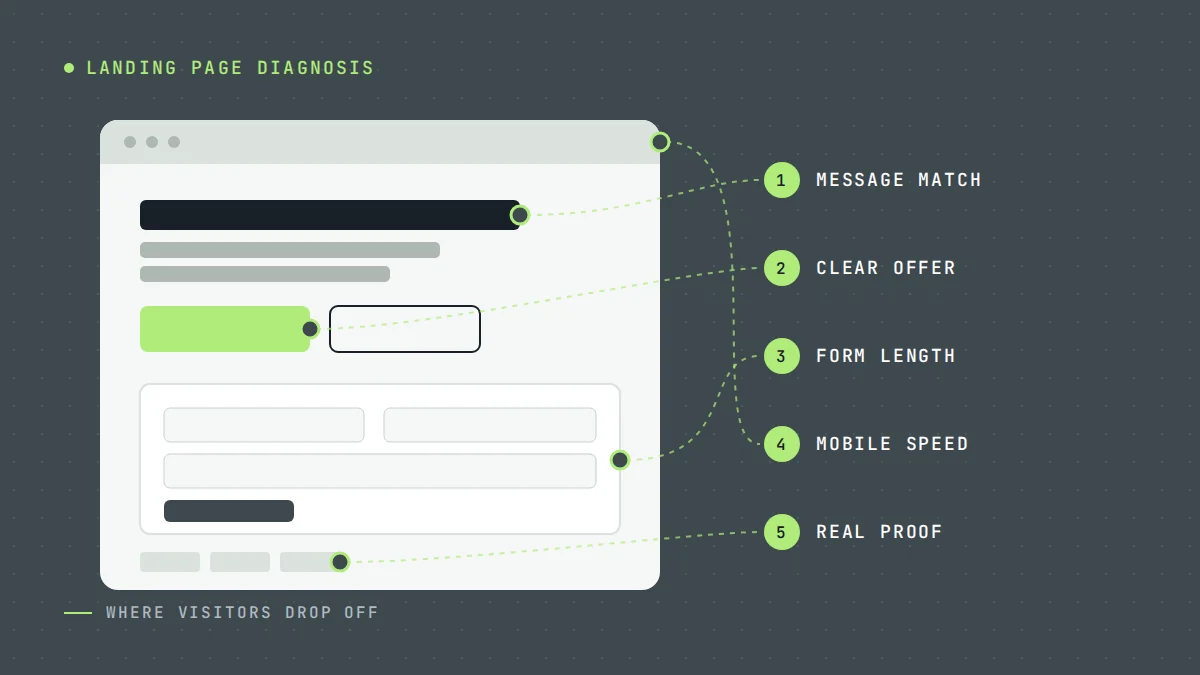
Each campaign, and ideally each major ad group, should land on a page about that specific service in that specific area, with a clear phone number and a short form. We cover the most common landing page problems in why your landing page is not generating enough leads.
Track calls and forms properly
Google's automated bidding learns from conversions. If your conversion tracking counts the wrong things, the bidding learns the wrong lessons.
For most service businesses, the core conversions are (see Google's guide to phone call conversion tracking):
- Calls from ads: calls placed directly from the ad on a phone.
- Calls from the website: calls from people who clicked the ad, then called from your site. This usually requires call tracking.
- Form submissions: completed enquiry forms, confirmed by a thank-you state or page.
Avoid counting soft actions, such as page views or clicks on a "contact" link, as primary conversions. They inflate results and mislead bidding. Once the basics work, the next step is feeding lead quality back to Google, for example with enhanced conversions for leads or by importing which leads were qualified or became customers, so bidding can learn which searches produce real work.
Budget and bidding basics
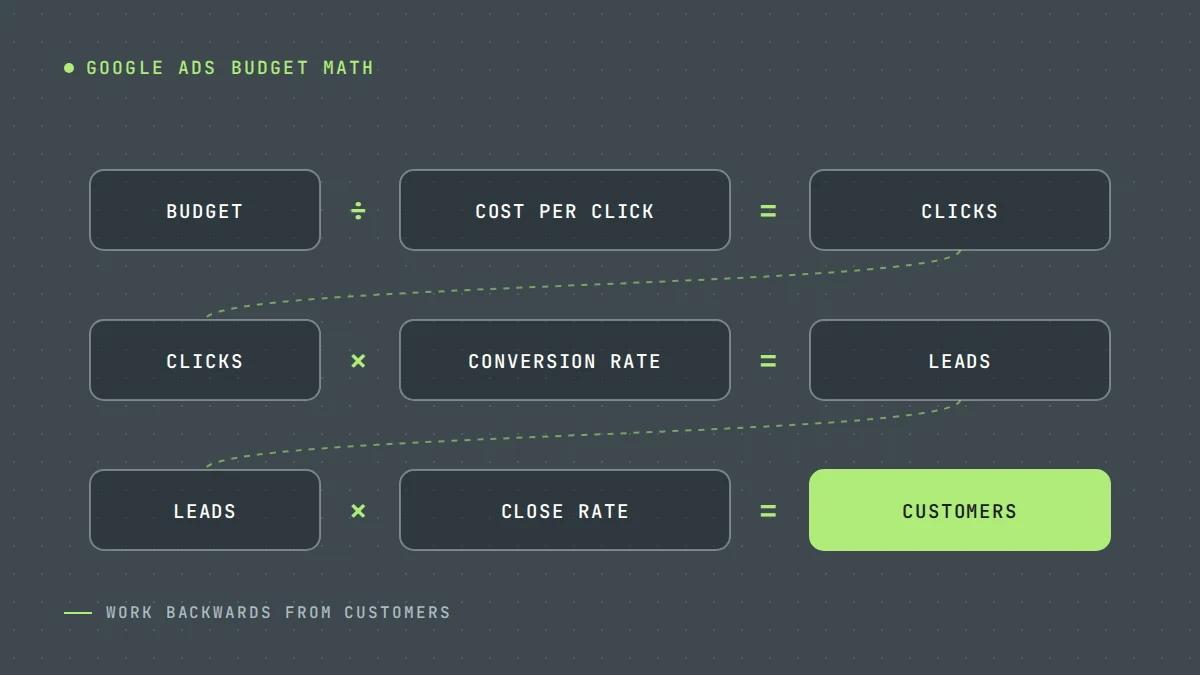
Budget should be set from your numbers, not from a round figure. The practical question is how many leads you need, what a click costs in your market and what share of visitors become leads. We walk through the math in how much does Google Ads cost for a service business.
On bidding: automated strategies such as maximizing conversions work best when conversion tracking is accurate and there is enough conversion data for the system to learn from. With little data, more manual control is often safer at the start.
A Google Ads launch checklist
- Conversion tracking for calls and forms is set up and tested.
- Campaigns are split by service, with budgets that reflect priorities.
- Location targeting matches your real service area.
- Ad schedules match when your team can answer the phone.
- A starting negative keyword list is in place.
- Each campaign has a matched landing page with a tappable phone number.
- Ads include call assets and relevant sitelinks.
- Someone is responsible for reviewing search terms every week in the early stages.
Google Ads for plumbers, HVAC companies, roofers and electricians
The structure above works for any trade. What changes is where the money is, and which searches waste it.
- Plumbers. Split emergency work (burst pipes, leaks, blocked drains) from planned work (water heater replacement, repiping). Run emergency campaigns only during the hours someone answers the phone, and make calling the main action. More on plumbing lead generation.
- HVAC companies. Separate repair from replacement and installation, and plan budgets around the weather. A replacement search such as "heat pump installation" is worth far more than a tune-up enquiry, so value them differently in reporting. More on HVAC lead generation.
- Roofers. Keep repair, replacement and storm work apart. Replacement searches are high value and heavily researched, so the landing page needs proof: photos of real roofs, warranties you actually offer, and reviews. Exclude supply and materials searches early. More on roofing lead generation.
- Electricians. Give panel upgrades, EV charger installation and rewiring their own ad groups and pages. Small jobs and big jobs look alike in search, so negative keywords and service-specific ads decide which one you pay for. More on electrician marketing.
For cleaning companies and landscapers the same rules apply, with more attention on service area and recurring work. See cleaning business marketing and landscaping marketing.
When to get help
Google Ads rewards steady, detailed attention: reading search terms, adjusting bids, refining pages and checking that tracking matches reality. If you do not have time for that, or your current account produces clicks but not enough real enquiries, it may be worth bringing in a specialist.
Our Google Ads management for service businesses is built around exactly this process, and the free audit shows you where your current account leaks before you spend another month finding out the hard way. For trade-specific detail, see how it applies to HVAC, plumbing and roofing companies.
Questions owners ask
Is Google Ads good for service businesses?
Usually, yes, when people search for the service in your area and your landing page and follow-up can turn clicks into jobs. It suits urgent and actively researched services best.
Which keyword match types should a service business use?
Many accounts start with exact and phrase match for control, and add broad match only once conversion tracking is reliable and someone reviews search terms closely. Google describes exact match as showing ads on searches with the same meaning or intent as the keyword.
What are negative keywords?
Negative keywords stop your ads from showing on searches that contain them, such as “jobs”, “salary”, “course” or “DIY”. They are one of the simplest ways to reduce wasted spend.
Is Google Ads worth it for a small business?
It can be, when people search for your service in your area and a new customer is worth more than it costs to win one. Estimate three numbers before you spend: what a click costs, what share of visitors enquire, and what share of enquiries become paying jobs. Our Google Ads cost guide walks through the math.
How do I set up Google Ads for a contractor business?
Set up conversion tracking for calls and forms first. Then create one campaign per main service, target only the areas you serve, add a starter negative keyword list, and send each campaign to a matching landing page with a phone number people can tap. Review the search terms report every week for the first few months.
Sources
Platform details in this article are based on the official documentation below. Platforms change their products often, so check the latest version before making decisions.
Want us to look at your own numbers?
Get a free lead generation audit. We will review your ads, landing pages and tracking, and show you where enquiries are slipping away. If nothing is broken, we will tell you that too.

LeadWise MarketingAn owner-operated lead generation agency based in Cape Town, South Africa, working with service businesses across the United States and Europe. More about LeadWise.